

Healing does not always begin with words. For many children, teens, and even adults, talking about difficult emotions or painful experiences can feel overwhelming.
Sand therapy offers a creative and effective way to express inner thoughts, explore emotions, and process trauma.
At Monmouth Integrative Counseling Services (MICS), we use sand therapy as part of our integrative approach to mental health treatment. With offices in Manasquan and Brick, New Jersey, and telehealth options statewide, our licensed therapists provide a compassionate, evidence-based space for clients to heal, grow, and regain balance in life.
What Is Sand Therapy?
Sand therapy is a form of play therapy and psychotherapy that uses a tray filled with sand and a variety of miniature objects or toys to create symbolic scenes. The client chooses figures, animals, buildings, or other items to create scenes that represent their inner world, emotions, and experiences.
The therapist observes quietly as the client engages with the sand. Using creative ways to express feelings that might be difficult to verbalize. This protected space provides emotional safety, allowing the client to explore complex emotions through the therapeutic process of symbolic play.
This approach originated with psychologist Dora Kalff, who combined Jungian training and the world technique developed by Margaret Lowenfeld to form what is now known as sandplay therapy. It has been refined over several years through research and practice by professionals and organizations such as the International Society for Sandplay Therapy.
How Sand Therapy Works
During a sand tray therapy session the therapist provides a shallow tray filled with sand, along with shelves of miniature objects. The client chooses items that resonate with their emotions and uses them to create a small “world” in the sand.
The process may involve storytelling, imaginary play, or quiet creation. As the scene unfolds, the therapist observes and provides a safe environment, allowing the client to express thoughts, feelings, and conflicts symbolically rather than verbally.
This humanistic approach encourages freedom, creativity, and self-expression. It helps people cope with difficult emotions, traumatic experiences, and behavioral problems in a nonverbal yet deeply meaningful way.
The therapeutic process often reveals patterns, memories, or beliefs that were previously unconscious. Over time, the sandplay becomes a bridge between the inner and outer worlds, leading to emotional release and healing.
The Purpose and Benefits of Sand Therapy
The main focus of sand tray therapy is to give clients a safe space to process emotions, build resilience, and reconnect with their sense of control. The evidence base for this technique continues to grow, with effectiveness studies in journals such as BMC Psychology and the International Journal of Play Therapy.
Sand therapy has been found to help clients with a wide range of mental health problems, including:
- Anxiety and generalized anxiety disorder
- Trauma and traumatic stress
- Behavioral problems in children
- Psychological distress
- Depression
- Sexually abused children and adults
- Those who have experienced displacement or cultural loss
- Adults coping with life transitions or unresolved grief
Research by mental health professionals highlights how sandplay therapy promotes emotional integration by engaging sensory, cognitive, and symbolic aspects of the mind.
Sand Therapy for Children
For children, sand tray therapy provides a natural way to express feelings through play therapy. Since children often communicate more easily through play than through conversation, the sand tray becomes their voice.
In a sand therapy session, a child may reenact family dynamics, create a fantasy world, or use miniature toys to represent fears, hopes, or conflicts. The therapist observes the process and, through gentle guidance, helps the child build insight and coping strategies.
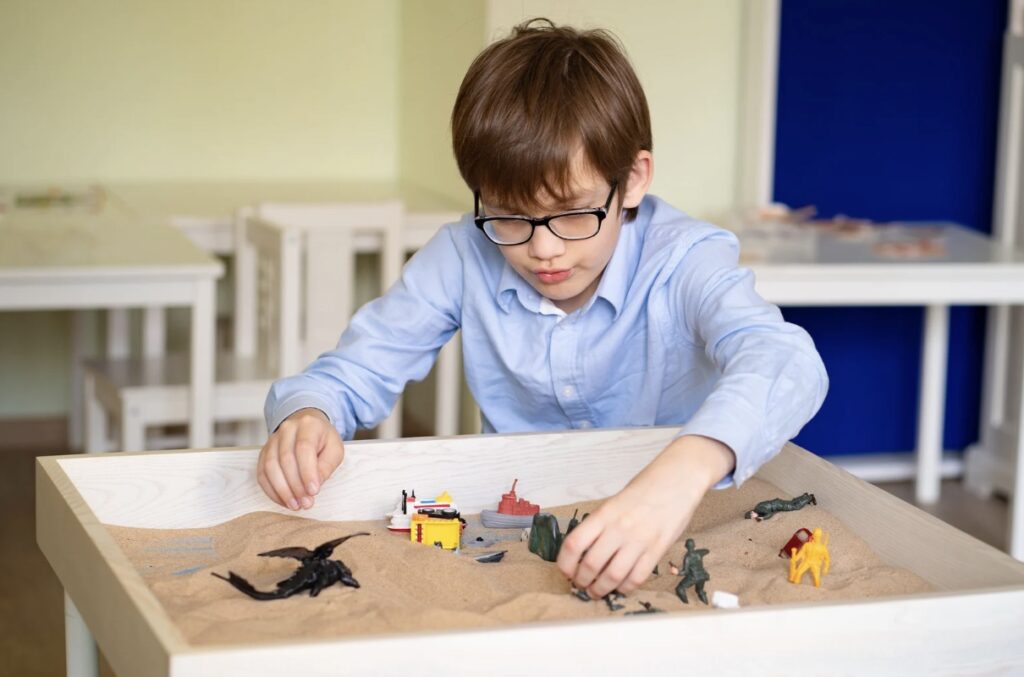
Children dealing with trauma, anxiety, or behavioral problems often show significant improvements after participating in sand play therapy, as it gives them a way to express emotions in a safe environment without pressure to explain or analyze them.
Sand Therapy for Adults
While many associate sandplay therapy with children, it is equally effective for adults. Adults facing mental health issues, traumatic experiences, or psychological distress can benefit from this creative process as much as any other form of therapy.
Adults use the tray to visualize emotional conflicts, explore inner thoughts, and find resolution for issues such as grief, anxiety, or trauma. This nonverbal technique allows people to bypass the limitations of talk therapy and access deeper emotional layers through symbolic representation.
Many adults find that the process of touching sand through sandplay promotes relaxation and reduces anxiety, similar to art therapy, while supporting insight and healing.
The Role of the Therapist
In sand therapy, the role of the therapist is to create and maintain a protected space where clients feel free to explore. The therapist provides the tray, sand, and miniature objects, then allows the client to work independently or with minimal guidance.
As the therapist observes, subtle themes and symbols emerge that can be discussed later in the session or across multiple sessions. Through this collaboration, the client develops insight, emotional regulation, and a sense of empowerment.
Our therapists at MICS are trained in play therapy, art therapy, and integrative counseling approaches, allowing them to combine sandplay therapy with other techniques for a well-rounded treatment experience.
The Healing Power of Sand Therapy
Sand therapy provides a safe environment for clients to process trauma, express emotions, and rebuild a sense of control. It allows both children and adults to explore the world within, giving shape and meaning to experiences that words alone cannot capture.
Through this creative process, clients reconnect with resilience, gain clarity, and experience genuine emotional healing. For those struggling with mental health problems, trauma, or psychological distress, sandplay therapy offers a unique path toward peace and self-understanding.
Contact us today to learn more about our sand therapy programs or schedule your first art therapy session in Manasquan, Brick, or online throughout New Jersey.
Call 732-231-5170 or Contact Us To schedule a consultation or learn more about Therapy in New Jersey
Monmouth Integrative Counseling Services
Manasquan & Brick, NJ
Phone: 732-231-5170
Monmouth Integrative Counseling Services
Manasquan & Brick, NJ
Phone: 732-231-5170